


* Hardcover: 552 pages
* Publisher: Sams (December 8, 2003)
* Language: English
* ISBN-10: 0672325977
* ISBN-13: 978-0672325977
Book Description:
In JavaServer Pages 2.0, Sun has added new features that make it even easier to create dynamic, interactive Web pages in Java. These include a built-in expression language and a library of tags (the JSP Standard Tag Library) that facilitate creation of pages.
Sams Teach Yourself JavaServer Pages 2.0 in 24 Hours starts with the basics of JSP, and explains the expression language, JSTL, creating new tags and more. Each lesson builds on the previous one, giving you a full picture of JSP development. Later chapters describe how to incorporate XML, interface with larger Java applications, work with popular frameworks such as Struts, and more. The book includes Apache Tomcat, Sun's reference implementation of JSP, so you can start developing applications immediately.
Download Description
Bridges the gap between .NET and .NET Compact Framework development. The Compact Framework brings familiar .NET development to mobile devices. This technology enables millions of Microsoft programmers to develop Windows CE applications. Written by two Microsoft Compact Framework team members. The primary goal of .NET Compact Framework is to bring the familiar experience of developing .NET applications for the desktop to the device world. Of the approximately six million Microsoft desktop developers in the world, it is estimated that perhaps two hundred thousand will turn their attention to the device world using the enabling technology of the .NET Compact Framework. To facilitate the goal of showing readers how to develop applications for the .NET Compact Framework, the book contains in-depth treatment in the following topic areas: Windows Forms and Threading, Network Programming, ADO.NET Dataset, XML Serialization, SQL CE, Web Services, and performance management. Each concept is accompanied with a sample application that illustrates its implementation on the .NET Compact Framework. For the convenience of the reader, each sample application will be offered in both C# and Visual Basic. Developers can use this source code as a springboard for creating their own device side database applications. Erik Rubin and Ronnie Yates are both uniquely qualified to write this book as they are on the .NET Compact Framework team at Microsoft Corporation and their experiences include work on a number of integrated technologies such as XML, Web Services, and ADO.NET.
:::Download Here:::



* Paperback: 586 pages
* Publisher: O'Reilly Media, Inc. (May 28, 2004)
* Language: English
* ISBN-10: 0596005385
* ISBN-13: 978-0596005382
Book Description:
In Microsoft's Office 2003, users experience the merger of the power of the classic Office suite of applications with the fluidity of data exchange inherent in XML. With XML at its heart, the new version of Microsoft's desktop suite liberates the information stored in millions of documents created with Office software over the past fifteen years, making it available to a wide variety of programs. Office 2003 XML offers an in-depth exploration of the relationship between XML and Office 2003, examining how the various products in the Office suite both produce and consume XML. Developers will learn how they can connect Microsoft Office to others systems, while power users will learn to create and analyze XML documents using familiar Office tools. The book begins with an overview of the XML features included in the various Office 2003 components, and explores in detail how Word, Excel, and Access interact with XML. This book covers both the user interface side, creating interfaces so that users can comfortably (and even unknowingly) work with XML, and the back end, exposing Office information to other processes. It also looks at Microsoft's new InfoPath application and how it fits with the rest of Office. Finally, the book's appendices introduce various XML technologies that may be useful in working with Office, including XSLT, W3C XML Schema, RELAX NG, and SOAP. Office 2003 XML provides quick and clear guidance to a anyone who needs to import or export information from Office documents into other systems. Both XML programmers and Office power will learn how to get the most from this powerful new intersection between Office 2003 and XML.
About the Author
Evan Lenz is an application developer whose primary expertise is in XSLT. As a member of the W3C XSL Working Group, he has been contributing to the development of XPath 2.0, XSLT 2.0, and XQuery 1.0. He has spoken at various XML conferences and helped author books including Wrox's "Professional XML, 2nd Edition", and "Early Adopter XQuery" (foreword). Evan holds a Bachelor of Music degree from Wheaton College, with majors in Piano Performance and Philosophy. He currently lives in Seattle, Washington, with his wife Lisa and son Samuel. Website: http://www.xmlportfolio.com.
Mary McRae has been working in the publishing industry for longer than she cares to admit. She learned to speak structured markup languages in 1992; she's been evangelizing the benefits of sgml and xml to publishers and documentation groups ever since. Her most recent adventures have taken her into the world of Microsoft Office 2003 and Smart Documents. In her spare time, Mary is a textile artist.
Simon St. Laurent is a web developer, network administrator, computer book author, and XML troublemaker living in Ithaca, NY. His books include XML: A Primer, XML Elements of Style, Building XML Applications, Cookies, and Sharing Bandwidth. He is a contributing editor to XMLhack.com
:::Download Here:::

* Paperback: 915 pages
* Publisher: McGraw-Hill Osborne Media; 3 edition (August 22, 2005)
* Language: English
* ISBN-10: 0072261544
* ISBN-13: 978-0072261547
Book Description
The new edition of this best-selling reference offers complete coverage of all aspects of the Red Hat Fedora and Enterprise Linux distribution. Full details on everything from installation and configuration to system administration and server management of Enterprise Linux--with specifics on the Linux Kernel 2.6--are included. The new IPv6 Protocol, including the network security features of IPSEC and Virtual Private Networks, are also covered. The DVD contains the entire Red Hat Fedora Core distribution--normally available on multiple CD-ROMs.
From the Publisher
Red Hat Enterprise Linux and Fedora Core 4: The Complete Reference provides a comprehensive examination of all aspects of Fedora Core 4 Linux, including recent critical changes in administration such as device management, kernel configuration, and IPv6 support. In terms of coverage, The Complete Reference is currently the only true Fedora Core 4 book, providing coverage of key Fedora Core 4 and even Fedora Core 3 developments. Other books in this class either take a different more introductory approach, or simply fail to cover key Fedora Core 4 developments. Only in this book will you find in depth discussion of key administration changes such as automatic device generation with udev, the Hardware Abstraction Layer (HAL), and kernel header management. It still remains the only text in its class that covers IPv6 topics ranging from network address auto-configuration to DNS records. In addition, there is special focus on security tools, providing dedicated chapters on SELinux, IPsec, and GPG encryption. The book remains the only text in its class to discuss Kerberos, as well as provide detailed examination of RAID and LVM file systems. The Complete Reference also covers the latest inclusions like the Global File System, detailing the various packages you need to implement the system, as well as upcoming solutions like using the latest securitylevel development version to enable Windows share browsing on Gnome. Though comprehensive in its handling of administration topics, The Complete Reference deals just as thoroughly with user topics, with beginning chapters providing introductory material, along with in depth chapters on Gnome, KDE, and shell usage and configuration. Office, Database, Multimedia, and Internet applications like Firefox, including Windows access and video support, are also covered. Dedicated chapters examine Internet services like Web servers, proxies, DNS, and FTP. Both the publisher and author have made a special effort to provide the most up-to-date and comprehensive information on Fedora Core 4 and Red Hat Enterprise Linux, keeping readers informed of all the latest developments.
:::Download Here:::

* Paperback: 986 pages
* Publisher: O'Reilly Media, Inc.; 2 edition (July 3, 2008)
* Language: English
* ISBN-10: 0596527217
* ISBN-13: 978-0596527211
Book Description:
After years of anticipation and delay, the W3C finally released the XSLT 2.0 standard in January 2007. The revised edition of this classic book offers practical, real-world examples that demonstrate how you can apply XSLT stylesheets to XML data using either the new specification, or the older XSLT 1.0 standard. XSLT is a critical language for converting XML documents into other formats, such as HTML code or a PDF file. With XSLT, you get a thorough understanding of XSLT and XPath and their relationship to other web standards, along with recommendations for a honed toolkit in an open platform-neutral, standards-based environment. This book: Covers the XSLT basics, including simple stylesheets and methods for setting up transformation engines Walks you through the many parts of XSLT, particularly XSLT's template-based approach to transformations Applies both XSLT 1.0 and 2.0 solutions to the same problems, helping you decide which version of XSLT is more appropriate for your project Includes profuse examples that complement both the tutorial and the reference material
The new edition of XSLT has been updated thoroughly to explain XSLT 2.0's many dependencies, notably XML Schema and XPath 2.0. Want to find out how the 2.0 specification improves on the old? This book will explain.
About the Author
Doug Tidwell is a senior programmer at IBM. He has more than a sixth of a century of programming experience, and has been working with markup languages for more than a decade. He was a speaker at the first XML conference in 1997, and has taught XML classes around the world. His job as a Cyber Evangelist is to look busy and to help people use new technologies to solve problems. Using a pair of zircon-encrusted tweezers, he holds a master's degree in computer science from Vanderbilt University and a bachelor's degree in English from the University of Georgia. He lives in Raleigh, North Carolina, with his wife and their daughter Lily.
:::Download Here:::

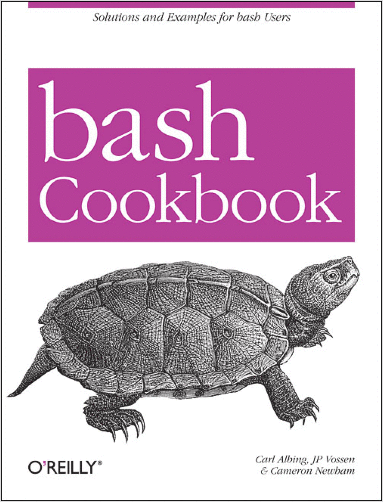
* Paperback: 622 pages
* Publisher: O'Reilly Media, Inc.; 1 edition (May 24, 2007)
* Language: English
* ISBN-10: 0596526784
* ISBN-13: 978-0596526788
Book Description:
The key to mastering any Unix system, especially Linux and Mac OS X, is a thorough knowledge of shell scripting. Scripting is a way to harness and customize the power of any Unix system, and it's an essential skill for any Unix users, including system administrators and professional OS X developers. But beneath this simple promise lies a treacherous ocean of variations in Unix commands and standards.
"bash Cookbook" teaches shell scripting the way Unix masters practice the craft. It presents a variety of recipes and tricks for all levels of shell programmers so that anyone can become a proficient user of the most common Unix shell -- the bash shell -- and cygwin or other popular Unix emulation packages. Packed full of useful scripts, along with examples that explain how to create better scripts, this new cookbook gives professionals and power users everything they need to automate routine tasks and enable them to truly manage their systems -- rather than have their systems manage them.
About the Author
Carl Albing has worked for large companies and small startups, in technical as well as in managerial and marketing roles. He wrote compiler software while at NCR, medical image processing software at a small startup, distributed computing software for the premier supercomputing company Cray Research, Inc. His experience in software development goes back to the early 1970's working with the C Language and Unix. In the last few years, he has put new Linux and Java technologies to use for real-world business solutions. His education includes graduate work in Computer Science as well as a degree in Mathematics and an International MBA.
JP Vossen is the Engineering Manager for Counterpane Internet Security where he works on the company's build automation process - which is largely built with bash scripts, Perl, SQL, and CVS.
Cameron Newham is an information technology developer living in the United Kingdom. Originally from Australia, Cameron completed a Bachelor of Science degree in information technology and geography at the University of Western Australia. In his spare time he can be found working on his project to digitally record buildings of architectural interest in England. He also has more than a passing interest in a diverse range of subjects including photography, space science, digital imaging, ecclesiology, and architectural history. He is the author of "Learning the bash Shell, Third Edition".
:::Download Here:::


